
Services
Wall Tiler in West London
Wall tiles are on show at eye level, so every cut, line and corner gets noticed. Good wall tiling is mostly about what happens before the tiles go up.
Walls in any room
Robert tiles walls in bathrooms, showers, kitchens, utility rooms, hallways and living spaces, from a single splashback to full-height walls and feature walls. Walls in older London homes are often uneven or out of plumb, and new plasterboard walls bring their own requirements, so every wall is checked before quoting.
Preparing the surface
Tiles need a sound, clean, flat surface. New plaster has to be fully dry and primed before tiling. Painted walls generally need the paint removed or scored and the wall primed so the adhesive can bond; tiling straight onto loose or glossy paint is a common cause of tiles coming away.
In showers and other wet areas, tile backer board and a waterproofing system are used rather than relying on plaster. Heavier tiles such as large porcelain or natural stone need a wall that can carry the weight, so check the tile and board manufacturers' limits.
Setting out and flat walls
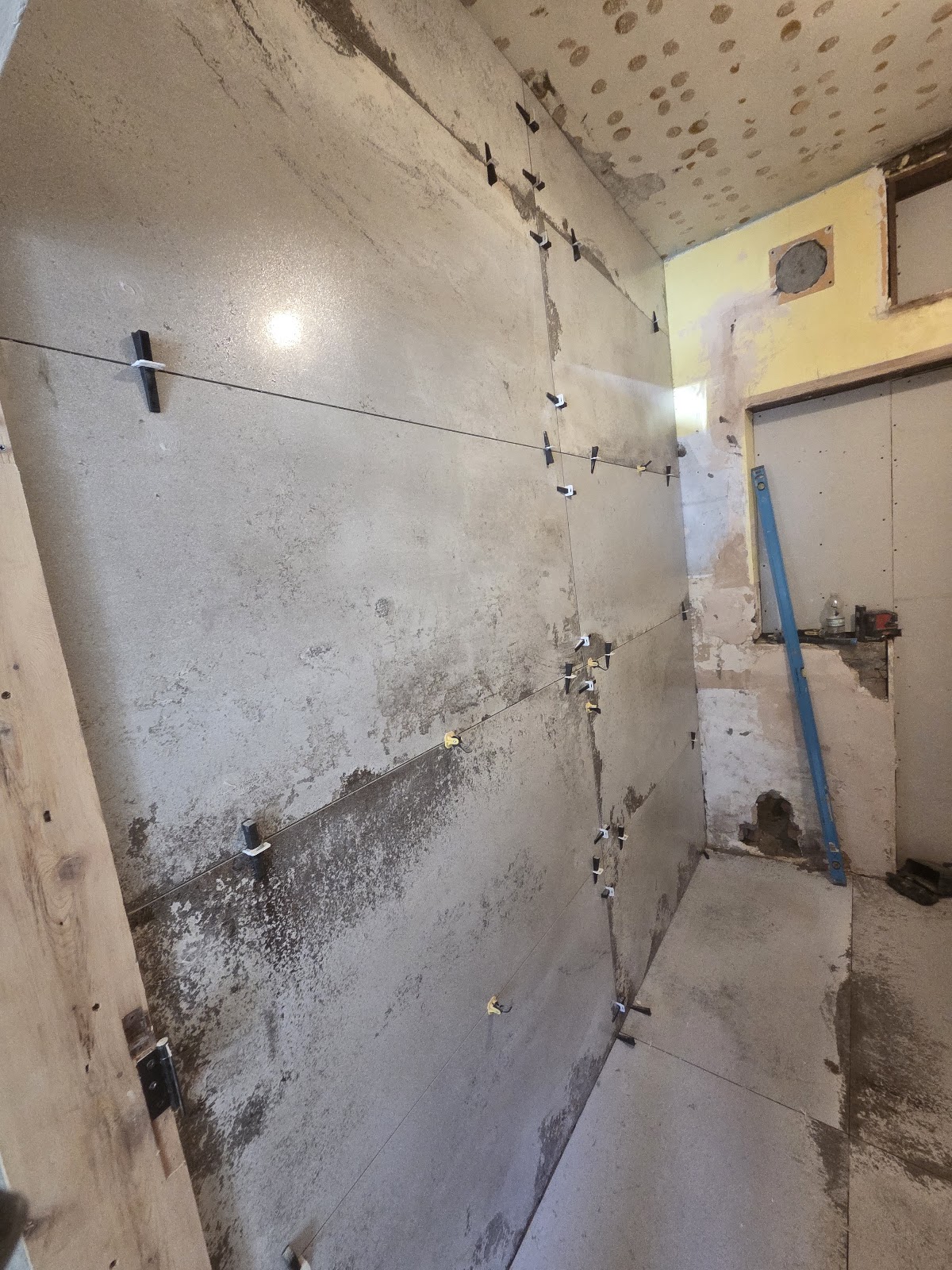
Before the first tile goes up, Robert plans the setting out: where the cuts fall, how the rows line up with windows, niches and the edge of the bath or worktop, and where the first full row starts. Walls that aren't flat are corrected first, because adhesive can't hide a bowed wall without leaving lips between tiles. Levelling systems help keep large tiles flush with each other.
Adhesive coverage, grout lines and corners
Tiles need full adhesive coverage on the back, especially in wet areas and with larger formats, so there are no hollow spots where water can sit or tiles can crack. Grout lines are kept straight and even, and external corners are finished with trims or mitred edges depending on the tile and the look you want.
Internal corners and junctions with baths, shower trays and worktops are finished with silicone rather than grout, because these joints move.
Feature walls with patterned or mosaic tiles
A feature wall can use patterned tiles, mosaics, metro tiles in a different bond, or a contrasting colour. With patterned tiles the layout is planned around the pattern repeat so it runs evenly across the wall. Mosaic sheets need careful alignment so the sheet joints disappear.
Robert Rajz is an NVQ Level 3 tiler with 18 years' experience, based in West Ealing, W13. He holds a Gold CSCS card, is DBS checked and fully insured, and is rated 5/5 on MyBuilder and 10/10 on Checkatrade.
FAQ
Common questions
What walls can be tiled? +
Most sound walls: plaster, plasterboard and masonry, as long as the surface is prepared properly. In showers and wet areas, tile backer board and waterproofing are used.
Do walls need to be flat? +
Yes. Walls must be flat enough for the tile size, and larger tiles need flatter walls. Uneven walls are corrected before tiling rather than built out with adhesive.
Can you tile over paint? +
Generally the paint is removed or scored and the wall primed first, so the adhesive bonds to a sound surface. Tiling onto loose or glossy paint is a common cause of tiles coming away.
Can you tile over existing wall tiles? +
Sometimes, if the old tiles are sound, firmly bonded and the wall can take the extra weight. Usually it's better to remove them and check the wall underneath.
Free quote
Tell us about your job
Tiling in West London?
Call Robert on 07427 725086 or request a free quote.
Based in West Ealing, W13. We cover North West London, South West London, Central London and North London. Other areas considered on request.
Area pages: West Ealing · Ealing · Isleworth · Putney · Wimbledon · Brixton · Lewisham · Hanwell